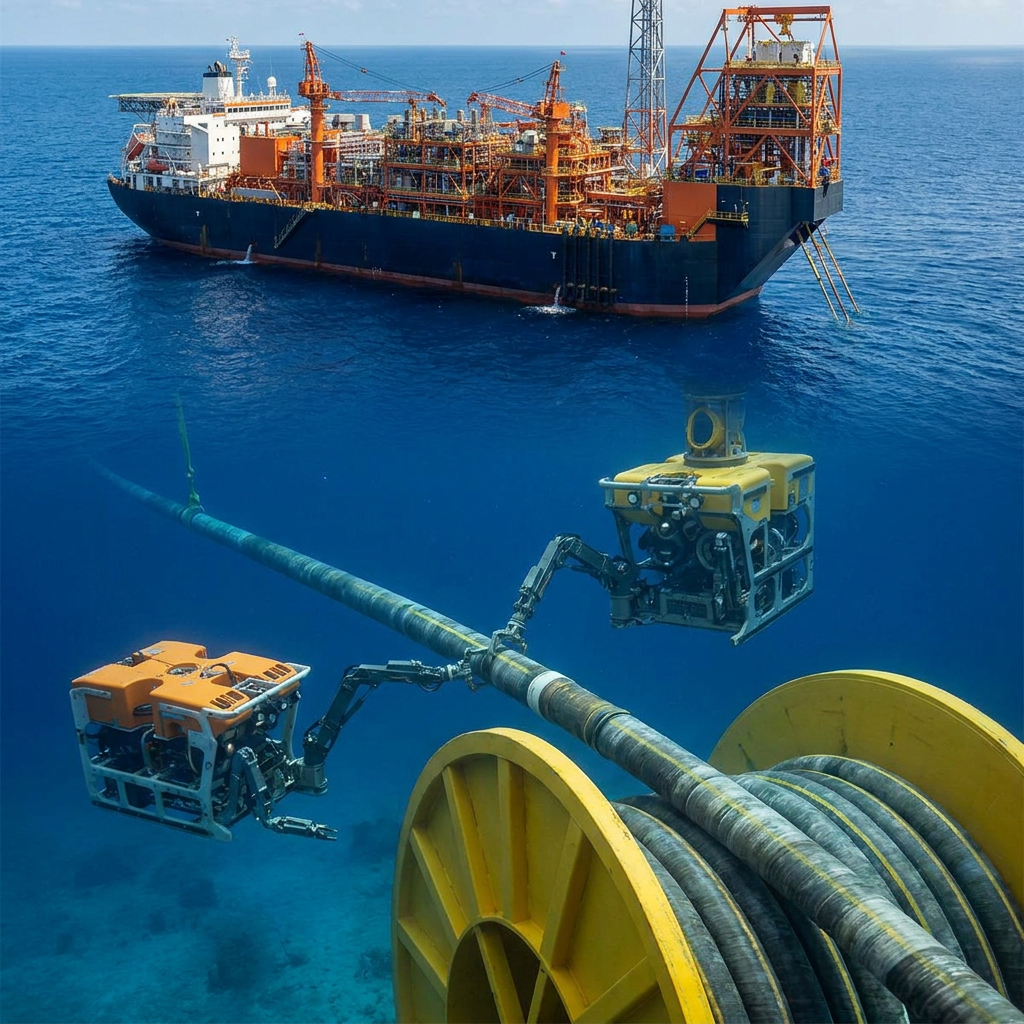
Strohm, a specialist in thermoplastic composite pipe (TCP) technology, has successfully completed a joint industry program (JIP) with Petrobras and Shell to qualify its TCP flowline for ultra-deepwater applications. The qualification clears the way for a planned pilot installation at a Petrobras-operated pre-salt field offshore Brazil, scheduled for early 2027. The program involved full-scale qualification and offshore field trials designed to demonstrate the TCP system under conditions representative of Brazil’s pre-salt reservoirs, where high CO₂ concentrations can severely corrode conventional flexible flowlines.
Following the DNV qualification, Strohm executed offshore field trials in July 2026 that included deep immersion performance tests and subsea vertical connection tests. These trials evaluated the flowline’s performance during offshore handling, installation, and subsea connection, confirming its readiness for commercial deployment. Completion of the qualification and offshore trials represents the final stage before Petrobras proceeds with the pilot installation and operation of the TCP flowline at a pre-salt field in early 2027.
The TCP flowline technology is designed to offer a corrosion-resistant alternative to steel and flexible pipe in high-CO₂ environments, a critical need for Brazil’s pre-salt fields, which contain significant amounts of CO₂. Conventional flowlines in these fields require costly corrosion management strategies, whereas TCP’s inherently inert composite structure resists chemical attack, potentially reducing lifecycle costs and improving operational reliability. Strohm’s JIP partners, Petrobras and Shell, bring deep expertise in deepwater production and a strong interest in qualifying new materials that can extend field life and reduce intervention costs.
This qualification marks a significant step for TCP technology in the offshore oil and gas sector, where the push for cost efficiency and reliability in increasingly challenging environments is driving adoption of advanced materials. Brazil’s pre-salt fields, which account for a large share of the country’s oil production, represent a key market for such innovations. The successful pilot could open the door to broader use of TCP flowlines in other deepwater basins, including the Gulf of Mexico and West Africa, where similar corrosion challenges exist.
Market observers note that Strohm’s TCP technology has already been deployed in shallower water applications for risers and jumpers, but this qualification for ultra-deepwater flowlines expands its addressable market significantly. Petrobras has been an early adopter of alternative materials, having previously tested flexible pipes and liners to manage CO₂ corrosion. The 2027 pilot will provide real-world performance data that could accelerate commercial adoption. For Shell, the qualification aligns with its strategy to deploy reliable, low-maintenance subsea equipment across its global deepwater portfolio.
Looking ahead, Strohm expects to leverage the qualification results to secure additional contracts in Brazil and other deepwater regions. The company is also exploring TCP applications for hydrogen transport and carbon capture storage, though oil and gas will remain the primary near-term focus. Industry analysts see this development as another example of technology innovation enabling operators to safely and economically produce from increasingly complex reservoirs, reinforcing the role of advanced composites in the future of subsea engineering.
Key entities: Strohm, Petrobras, Shell, TCP flowline, pre-salt fields, DNV, ultra-deepwater
Source: worldoil.com · 2026-09-22 · https://www.worldoil.com/news/2026/9/22/petrobras-shell-qualify-strohm-tcp-flowline-for-brazil-ultra-deepwater-operations/